

April 2026 - V3.05 Rules Update
- Joe Dawson

- Apr 12
- 9 min read
We are excited to bring players the 3.05 rules update for Highlander: The Card Game.
This update introduces two foundational changes to the game: a rework of the Hard Exertion rule and the introduction of fully sequential attack and defense resolution.
Together, these changes clean up long-standing edge cases in competitive play, open up new design space, and make every exchange at the table more dynamic and strategic. For a deeper look at the thinking behind these changes, check out our accompanying blog post.
Below you'll find a quick breakdown of the most important changes and updates included in V3.05. We strongly suggest you download the latest rulebook and go to the very last section, where EVERY update in V3.05 is detailed.
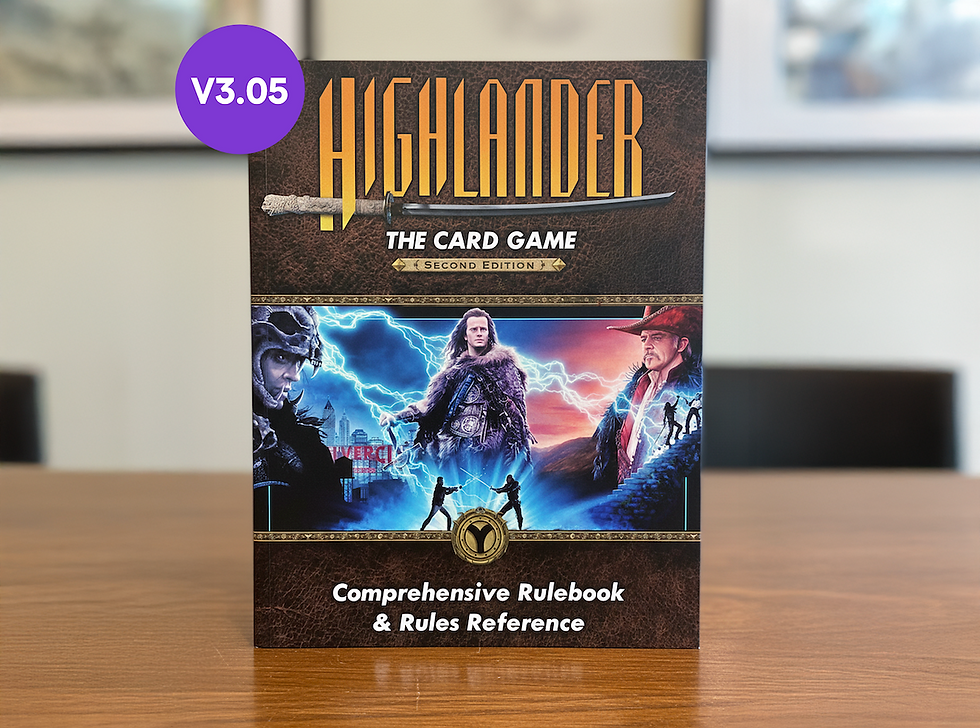
Major Change: Sequential Attack Resolution and Hard Exertion rule updates
Two of the biggest changes in V3.05 are also the two that make the game much more fun to play. We have a dedicated article covering the details about why these two updates have been made. Read about it here.
Sequential Attack Resolution - Pending Attacks resolve sequentially in the order in which they appear in the Attack Chain. Each Pending Attack resolves to become either declared successful or declared unsuccessful depending on whether that Attack is defended or not. Hard Exertion Updates - To make the change to sequential attack resolution possible, the rules team had to address Hard Exertions. Making a Hard Exertion no longer completely locks you out of playing cards from your Hand. After making a Hard Exertion, the only cards you can play from your Hand for the rest of that phase are gridded cards and one card played in conjunction with each such gridded card played after the Hard Exertion.
Key Updates in V3.05
The Golden Rules of Highlander the Card Game (amended entry)
1.) Turns Belong to the Active Player
A player cannot normally perform actions during their opponent’s turn. There are, of course, some exceptions such as Attribute Challenges, Trigger effects and Wounds, but the Swordmaster System allows players the opportunity to execute their moves and create their combos before their opponent has the chance to answer or interrupt them.
2.) You Must Take Action
If a player is legally able to do so, and no effects in play stop them, they must play a non-Edge card (Attack, Defense, or Special Card) or make a Hard Exertion during their turn.
3.) There Can Be Only One
A player can normally perform each of the following actions once during their turn
• Play one Attack per turn.
• Play one Defense to defend against each Attack their opponent plays.
• Play one Special Card per turn.
• Make one Hard Exertion per turn.
• Make one Power Blow per turn
4.) Card Text Overrides Rules
If the printed text on a card directly contradicts the rulebook, the card text takes precedence. Cards are designed to create exceptions to the normal rules of play. When this occurs, follow the instructions on the card.
Combat Area (amended entry)
The Combat Area is the section of play where attacks & defenses are played as well as Edge cards, Illusions, Events, and un-inflicted Wounds. This is a Public Section unless an effect or Card Text allows a player to play a card face down, like a Hidden Attack or an un-inflicted Wound. Typically, only cards that have one turn effects or stay in play for one turn are played in the Combat Area. Attacks get played here and make up your Attack Chain.
Attack Phase Updates (amended entry)
This is the Phase where you can play or put into play Attacks.
Your Attack Chain represents the sequence of Attack opportunities you have during your Attack Phase. By default, your Attack Chain contains one Attack opportunity—your Primary Attack Opportunity (also called your Primary Attack Slot).
When preparing to attack, take note of the last resolved Defense you played or put into play, as it may modify your Primary Attack Opportunity.
If the last Defense you played or put into play was a Block, the Attack you play or put into play using your Primary Attack Opportunity cannot share active grid squares with any of the active grid squares of that Block. This rule is known as “you may not attack to areas you just blocked.”
Important: This rule applies only to the Attack you play using your Primary Attack Opportunity—it does not apply to any additional Attack opportunities that may follow it in your Attack Chain.
Cards or effects that state “your first Attack” refer specifically to the Attack you assign to your first Attack Opportunity (typically your Primary Attack). Cards or effects that state “the first Attack you play” refer to the first Attack actually played during your Attack Phase, even if that is not the one played using your Primary Attack Opportunity.
A successful Dodge will also defend against an Attack and may affect your next Attack, depending on its Card Text, if any.
Certain cards or effects that allow you to “play an additional Attack” or grant “an additional Attack opportunity” both refer to the same concept—they each add one Attack opportunity to your Attack Chain. Each opportunity in the Attack Chain may only be used once and must be used in order.
If you have more than one Attack opportunity in your Attack Chain, you may declare that you are skipping your Primary Attack Opportunity. Doing so allows you to proceed directly to your next available Attack opportunity (for example, one granted by Extra Shot). Once you declare that you are skipping an Attack opportunity, you cannot return to it later in the same Attack Phase or use any effect to regain that skipped slot. Losing an Attack or Attack opportunity—such as from playing an Evade: Escape—is not a Restriction effect. Loss effects remove Attack opportunities from your Attack Chain. Restriction effects restrict you from playing an attack.
If you are prevented or restricted from playing an Attack, or if you have lost all of your Attack opportunities, then you cannot play an Attack or make a Hard Exertion for one.
If you have not played a Special Card yet, this is your last opportunity to do so. Remember that you may only play one Special Card per turn.
Defense Phase Updates (amended entry)
This is the Phase where you can play—from your Hand or from a Hard Exertion—gridded Defenses to avoid or block your opponent’s Attacks. The Defense Phase is the only Phase of you turn where you can play for put Gridded Defenses into play. If there is no Pending Attack, you cannot play a gridded Defense or make a Hard Exertion for a gridded Defense. If there is no Pending Attack, you can put one unprovoked gridded Guard into play.
If your opponent plays one Attack—you may play one Defense to defend that Attack. All Pending Attacks must be resolved during your Defense Phase in the order in which they appear in the Attack Chain. A Pending Attack can resolve in one of two ways:
1.) The Pending Attack is declared successful.
2.) The Pending Attack is declared unsuccessful due to a successful Defense or other effect that avoids the Attack.
If a player decides to forgo defending or avoiding a Pending Attack, it resolves by being declared successful. Its effects (if applicable) resolve immediately, and the Attack Damage becomes pending for the upcoming Ability Adjustment Phase.
If a player decides to defend against a Pending Attack—either by playing a defense, putting one into play, or using a Standing Defense already in play etc—and that defense successfully defends the Attack, the defense is declared successful and the attack resolves by being declared unsuccessful.
Some Defenses have effects that occur after they are successful. Most of these effects occur in your Attack Phase. Some defenses have effects that are immediate after they are declared successful—e.g draw a card etc. It is important to note that only the last Defense you play, put into play, or use during your current Defense Phase carries over to your Attack Phase and beyond.
A Defense that has been declared successful and that could successfully defend against another Attack in the same Attack Chain may continue to defend subsequent Attacks while it remains in play, until you choose to play or put another Defense into play.
When a Successful Defense is carried forward to defend a later Attack in the Attack Chain, it must still be legal to defend against that Attack within the current game state and must cover every area on the Grid Icon of that Attack.
Once a Pending Attack has resolved, players proceed to resolve the next Pending Attack in the Attack Chain until no Pending Attacks remain.
As If From an Exertion (amended entry)
Some cards and effects allow you to play a card “as if from an Exertion.” These are powerful effects that allow you to gain the benefits of playing a card from a Hard Exertion without actually making one.
To play a card “as if from an Exertion,” you must be able to make a Hard Exertion at that time (i.e., you have not made a Hard Exertion this turn and no effect prevents you from making one).
If a card instructs you to play a card “as if from an Exertion,” it is treated as being played from a Hard Exertion unless otherwise specified.
Playing a card “as if from an Exertion” does not count as making a Hard Exertion and does not take away your ability to make a Hard Exertion.
Effects that modify the result or size of a Hard Exertion (including reducing it to 0) do not prevent you from playing a card “as if from an Exertion.”
You can only play one card per turn “as if from an Exertion,” unless an effect states otherwise.
You can play cards in conjunction with cards played “as if from an Exertion,” as long as the cards are played and not put into play by an effect.
Attack Resolution (new entry)
Pending Attacks resolve sequentially in the order in which they appear in the Attack Chain. Each Pending Attack resolves to become either declared successful or declared unsuccessful depending on whether that Attack is defended or not.
If a player chooses not to defend against a Pending Attack, or use another effect to avoid it, the Attack resolves by being declared successful. Any resulting effect of a successful Attack is an Immediate Effect that activates as soon as it is declared successful.
The damage from the Attack is then pending and will modify the player’s Ability during their next Ability Adjustment Phase. Pending Attack Damage is activated as soon as the Attack is declared successful. Removing, ignoring, or Capturing a successful Attack from play does not negate or prevent the Pending Attack Damage caused by that Attack. The Pending Attack Damage will still resolve during the Ability Adjustment Phase unless a card or effect specifically states that it can reduce or prevent the Damage from a successful Attack.
A Pending Attack resolves to be declared unsuccessful if a Defense successfully avoids or blocks that Attack. When this occurs, the Defense is declared successful and the Pending Attack is declared unsuccessful.
Because Pending Attacks resolve one at a time, the outcome of an earlier Attack in the Attack Chain may affect how later Pending Attacks resolve. Any effects that occur when an Attack is declared successful occur immediately before the next Pending Attack in the Attack Chain resolves.
For example, if the first Attack in the Attack Chain states that if it is successful you must Burn 5 cards from your Endurance, if that attack is declared successful you must Burn 5 cards from your Endurance before you resolve any other Pending Attacks.
Once a Pending Attack resolves and is either declared successful or declared unsuccessful, players proceed to resolve the next Pending Attack in the Attack Chain until no Pending Attacks remain.
Dual Subtitled Cards (new entry)
Dual Subtitled cards are cards that contain more than one Persona name in the Card Subtitle, indicating that all named Personas can include and use those cards in their deck without an Allowance effect.
Hard Exertions (amended entry)
Making a Hard Exertion will limit the types of cards you can play from your Hand for the remainder of that phase. After making a Hard Exertion, the only cards you can play from your Hand for the rest of that phase are gridded cards and one card played in conjunction with each such gridded card played after the Hard Exertion.
Because of this, it is important to remember that while you may continue to play cards from your Hand after making a Hard Exertion, there are instances where you will need to play all cards you wish to play before making the Hard Exertion.
For example, you may wish to play a Basic Attack and make that Attack a Power Blow by making a Hard Exertion. If you also want to play a card in conjunction with that Attack, such as Amanda Seduce, you must play that card before making the Hard Exertion. Once the Hard Exertion is made, you may only play gridded cards and one card in conjunction with each such gridded card played after the Hard Exertion.
You can find the comprehensive rule book as a downloadable PDF here.

Comments